

In today’s labor market, job security is not just a worker preference, it’s part of how employees evaluate the value of a role.
According to Monster’s Job Security Report, more than half of U.S. workers, 54%, say they would accept a pay cut in exchange for greater job security. The report also found that 61% would be willing to give up at least one aspect of their compensation or workplace experience for more stability.
The findings in this report point to an important shift in the retention conversation. Compensation still matters, but many workers are also weighing whether their current or future employer can offer stability, transparency, and confidence in what comes next.
Key Findings For Employers
- More than half of workers would accept a pay cut for greater job security: 54% say they would reduce their salary in exchange for more stability.
- Some workers would make meaningful financial tradeoffs: 26% would accept a pay cut of up to 5%, while another 28% would accept a reduction of 5% or more, including 11% who would accept a pay cut greater than 10%.
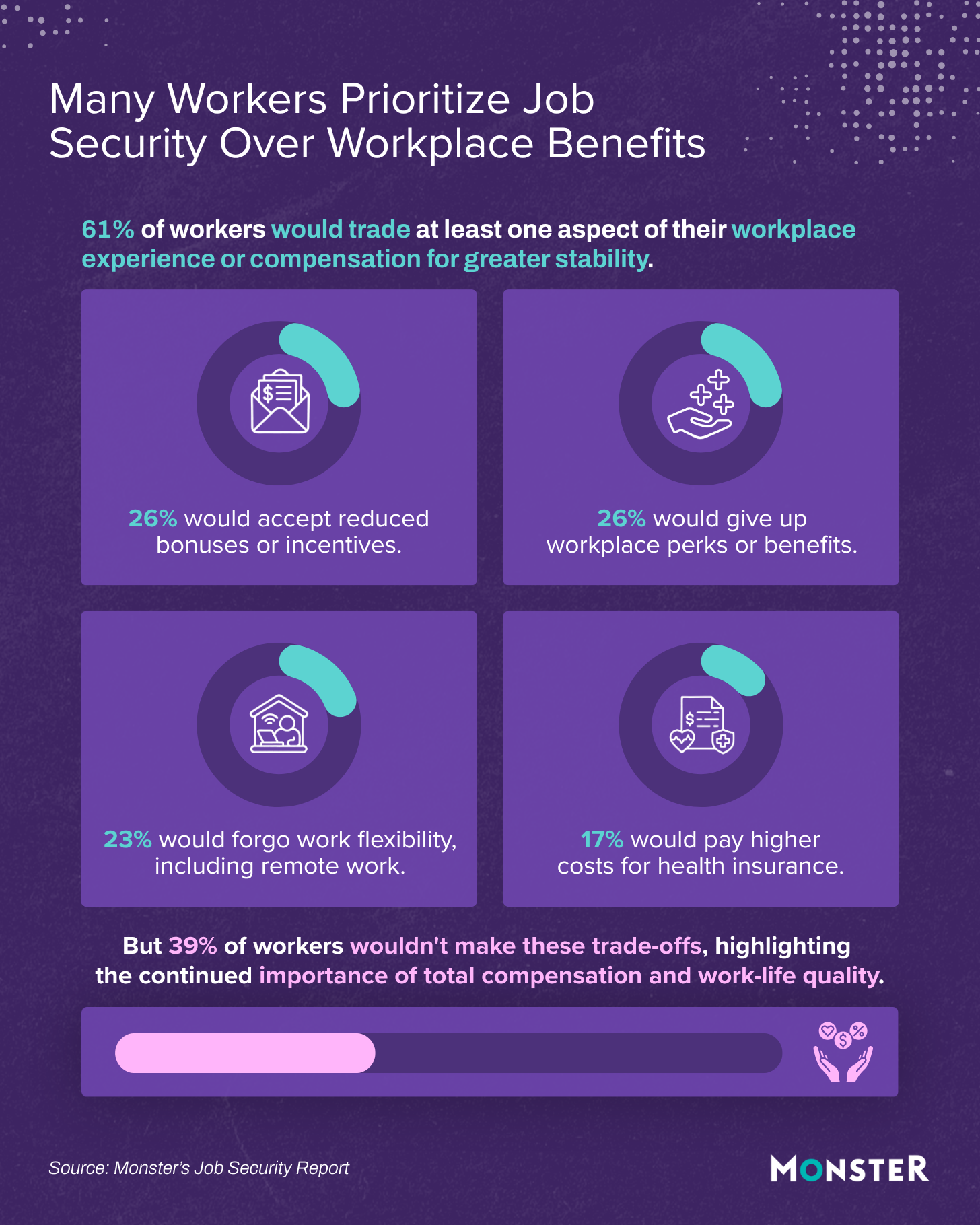
- Workers would give up more than salary: 26% would accept reduced bonuses or incentives, 26% would give up workplace perks or benefits, 23% would sacrifice workplace flexibility, and 17% would accept higher health insurance costs in exchange for greater job security.
- Most workers would make at least one tradeoff for stability: 39% say they would not be willing to make any of these tradeoffs, meaning 61% would sacrifice at least one aspect of their compensation or workplace experience for greater job security.
What This Means For Employers
Workers are not saying pay, benefits, flexibility, or workplace perks no longer matter. They are saying stability has become valuable enough to compete with those priorities.
That matters for employers because job security can influence how candidates evaluate new opportunities, especially entry-level talent weighing salary, stability, and long-term career growth.
Hiring and HR teams have an opportunity to make job security part of a broader employee value proposition. Employers that can communicate stability, growth opportunities, and organizational direction clearly may be better positioned to earn trust with both current employees and candidates.
Job Security Is Becoming Part Of The Compensation Conversation
Monster’s research found that 54% of workers would accept a salary reduction in exchange for greater job security. That includes 26% who would accept a pay cut of up to 5% and another 28% who would accept a pay cut of 5% or more.
This doesn’t mean employers should view job security as a replacement for competitive pay. Instead, it shows that workers are evaluating compensation through a broader lens. Stability, predictability, and confidence in the future can all shape how employees perceive the overall value of a role.
For employers, this makes job security an important part of total rewards messaging, especially in a labor market where workers may be cautious about making career moves.
Workers Would Trade More Than Pay For Stability
The willingness to make tradeoffs extends beyond salary. In exchange for greater job security, 26% of workers would accept reduced bonuses or incentives, 26% would give up workplace perks or benefits, 23% would sacrifice workplace flexibility, and 17% would accept higher health insurance costs.
These findings suggest that stability is competing with several parts of the workplace experience that have become central to retention and recruiting strategies.
For employers, the takeaway is not to reduce benefits or flexibility. It is to understand that workers may be placing a higher value on security than employers realize. A strong employee value proposition should account for both: the stability workers want and the flexibility, benefits, and pay they still value.
Stability Can Strengthen Retention And Employer Trust
Job security is closely tied to trust. When employees feel informed about company priorities, team structure, performance expectations, and future opportunities, they may be more likely to feel secure in their roles.
That sense of security can matter during periods of economic uncertainty, organizational change, or shifting workforce needs. Workers who do not feel confident about their future may begin comparing opportunities differently, even if they are not actively looking for a new job. This connects to the broader trend of job hugging, where employees stay put for stability even when they may not feel fully engaged or committed long term.
For employers, clear communication can help reduce uncertainty. Managers and leaders can support retention by being transparent about priorities, explaining how roles connect to business needs, and helping employees see a path forward inside the organization.
The Recruiting Impact Of Job Security
Job security can also influence how candidates evaluate new opportunities. A role with strong pay may still feel risky if the employer does not communicate clearly about expectations, stability, growth, or long-term need.
That makes security an important part of job postings, interviews, and employer brand messaging. Employers do not need to promise certainty they cannot guarantee. But they can be clear about why a role exists, how success will be measured, what growth can look like, and how the organization supports employees through change.
In a cautious labor market, candidates may be looking for more than a strong offer. They may be looking for confidence that the opportunity is built to last.
How Employers Can Respond
Employers can strengthen trust by treating job security as part of the broader workforce strategy.
- Be transparent about business priorities. Employees do not need every internal detail, but they do benefit from clear communication about company direction, team goals, and how their work supports the organization.
- Clarify role expectations. Workers may feel more secure when they understand what success looks like, how performance is evaluated, and how their role contributes to business needs.
- Connect stability to growth. Career development, upskilling, internal mobility, and manager support can help employees see a future with the organization.
- Balance security with the rest of the employee experience. Stability matters, but workers still value pay, benefits, flexibility, and affordable healthcare. The strongest retention strategies address both security and overall workplace value.
- Use job security carefully in recruiting messages. Employers should avoid overpromising, but they can communicate the purpose of a role, the long-term need for the position, and the support available to employees.
Bottom Line
Monster’s Job Security Report shows that stability has become a powerful part of how workers evaluate employment. Many workers are willing to trade salary, bonuses, benefits, or flexibility for greater confidence that their job will last.
For employers, that does not mean job security replaces competitive pay or a strong employee experience. It means stability should be part of the conversation. Organizations that can offer clear communication, realistic expectations, growth opportunities, and a sense of direction may have an advantage in attracting and retaining workers who are looking for confidence in uncertain times.
Methodology
This survey was conducted by Pollfish on July 17, 2026, among 1,020 currently employed U.S. workers. Respondents answered multiple-choice questions exploring attitudes toward job security, willingness to make workplace tradeoffs, compensation preferences, and career decision-making.
The sample included employed adults across a range of industries, company sizes, and work arrangements throughout the United States. Respondents identified their gender as 52% female and 48% male. Age distribution included 10% ages 18-24, 20% ages 25-34, 19% ages 35-44, 18% ages 45-54, 20% ages 55-64, and 13% age 65 or older. Respondents reported working fully remote, hybrid, and fully in-office schedules.