
As job switching stalls, growth must happen inside the role, not through the next offer.
For years, job mobility was a defining feature of the U.S. labor market. Workers changed roles frequently, and employers competed fiercely for talent by offering better pay, career growth, and mobility. That dynamic didn’t just drive wage growth; it shaped worker psychology. In addition to a financial strategy, changing jobs was viewed as a way to grow skills, affirm identity, and pursue meaning.
That model has changed.
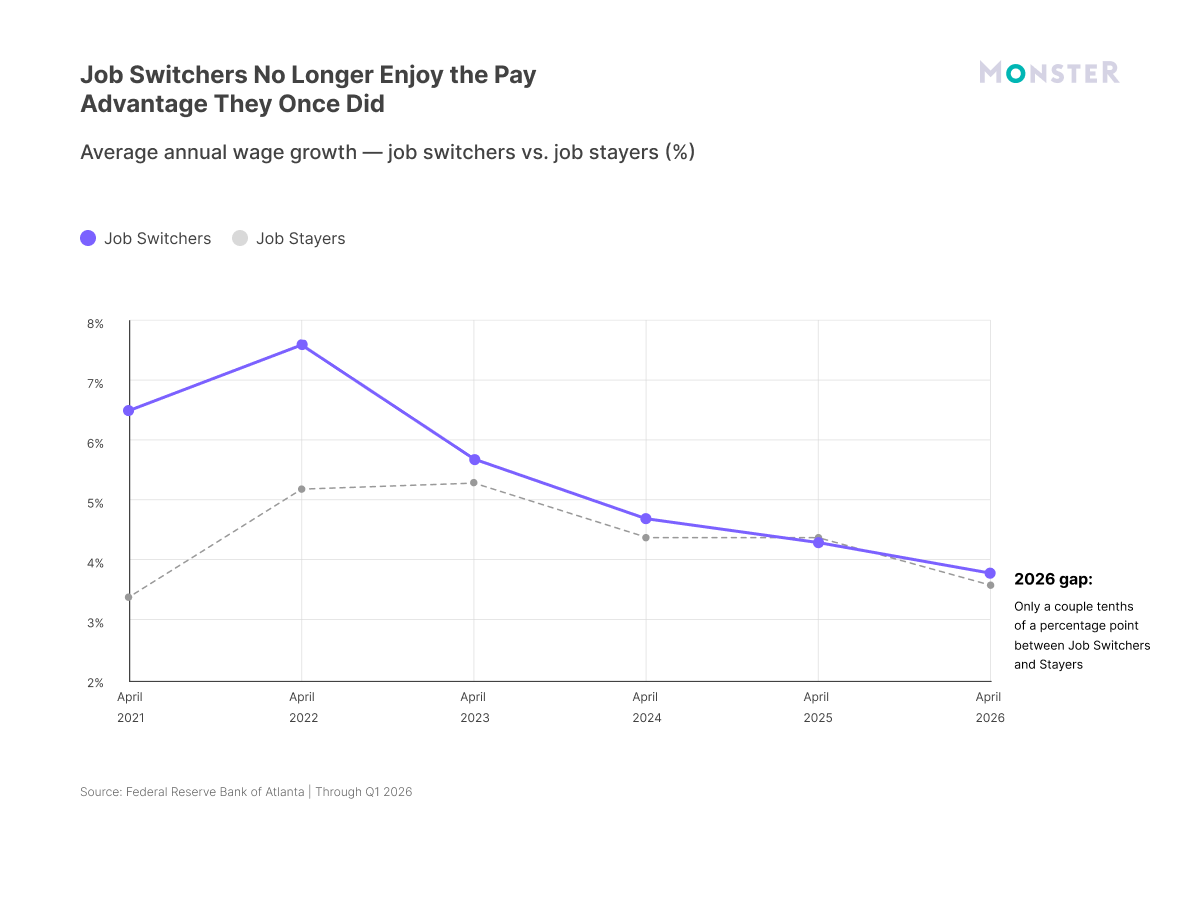
Recent labor market data shows that the economic premium for job switching has shrunk significantly. According to the Federal Reserve Bank of Atlanta’s Wage Growth Tracker, job switchers saw wage growth of 3.8% in April 2026, only slightly above the 3.6% wage growth reported for workers who stayed put. That marks a sharp shift from the elevated job-switching premiums seen during the tighter labor market of 2022 and 2023. At the same time, quit rates have fallen from pandemic-era highs, suggesting workers may be approaching job changes more cautiously as the potential reward no longer clearly outweighs the risk, disruption, or uncertainty of changing employers.
At Monster, our latest research captures this trend clearly. Forty-eight percent of workers say they are currently job hugging, intentionally staying in their roles rather than exploring new opportunities. Seventy-five percent expect to remain with their employer for at least the next two years. Only 43 percent plan to search for a new job in 2026, down sharply from 93 percent who reported job search intent just one year earlier.
This is not simply a cyclical response to uncertainty. Workers are weighing career risk in new ways. And for employers, there’s a productivity, performance, and retention story hiding in plain sight.
When external mobility slows, growth doesn’t disappear. It has to be redesigned inside the role. That is where job crafting enters the picture.
Retention Is Not Engagement
One of the most persistent errors organizations make in low-mobility environments is equating retention with engagement. When people are not leaving, leaders assume they are satisfied, committed, and productive. Decades of research in organizational psychology suggest otherwise.
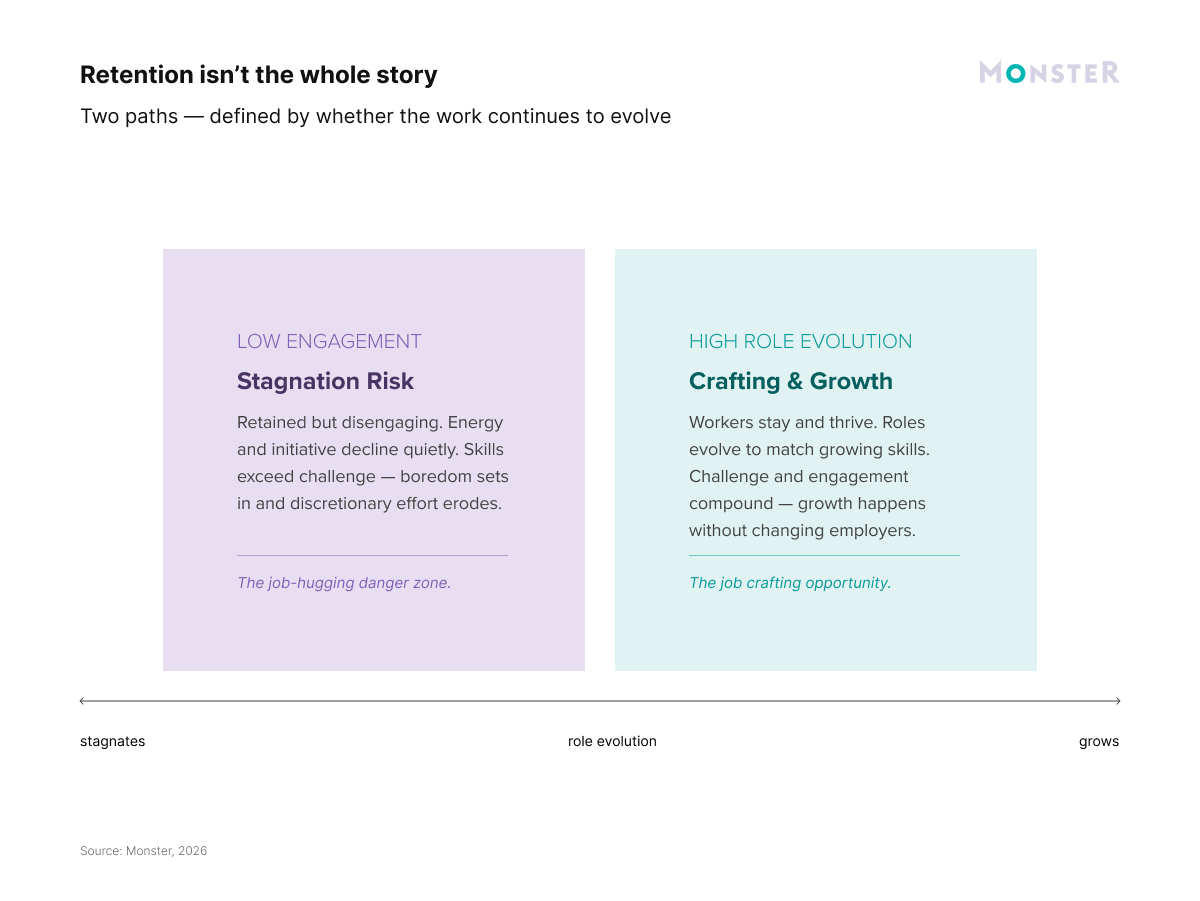
Work motivation is driven by more than financial incentives or job security. Self-determination theory, one of the most widely cited frameworks in the field, points to autonomy, competence, and relatedness as foundational human needs at work. When these needs are met, people tend to bring energy and initiative. When they are not, people adapt. They do not always quit. Instead, disengagement often shows up incrementally.
This is what makes job hugging such a deceptive signal.
Across large-scale job search platforms like Monster, early signs of disengagement show up well before resignation. They appear in what people explore, such as future roles, skills, and career paths, not just where they apply. Our data shows that while most workers expect to stay put, a much smaller share are actively exploring future opportunities. That gap suggests constraint, not contentment. People may be staying because leaving feels risky or unrewarding, not because their work feels meaningful or developmental.
From an employer’s perspective, this creates what I think of as a false equilibrium: Headcount remains stable, yet underlying engagement erodes.
I’ve seen organizations celebrate record retention while missing early warning signs. The same few people carry the thinking in every meeting. Projects stall without clear ownership. High performers quietly stop raising their hands. When the labor market eventually loosens, turnover doesn’t arrive gradually. It arrives all at once.
The Psychology of Stagnation
Psychology offers a useful lens for understanding what happens when people remain in roles that no longer challenge them.
Research on flow states, most notably by Mihaly Csikszentmihalyi, shows that people tend to be most engaged when their skills and challenges are well matched. When challenge exceeds skill, anxiety dominates. When skill exceeds challenge, boredom and apathy emerge. Long tenure without role evolution tends to push workers into the latter condition.
Importantly, boredom is not benign. Over time, it can lead to withdrawal of effort and a narrowing of identity. People protect their self-concept by convincing themselves that the work does not matter. From an organizational standpoint, this results in lower discretionary effort and weaker outcomes, even when employees remain technically “retained.”
This dynamic cannot be addressed with surface-level interventions such as title inflation or symbolic promotions. Without meaningful changes in challenge or scope, these tactics function as temporary psychological bandages.
Job Crafting as a Corrective Mechanism
Job crafting offers a more durable response.
Originally articulated by organizational psychologists Amy Wrzesniewski and Jane Dutton, job crafting refers to the ways individuals proactively reshape their tasks, relationships, and cognitive framing of work to better align with their strengths and values. Subsequent research has linked job crafting to higher engagement, stronger well-being, and reduced burnout risk.
What makes job crafting especially relevant in today’s labor market is that it creates internal mobility when external mobility is constrained. It allows workers to experience progress without changing employers.
From a psychological perspective, job crafting restores agency. It reintroduces challenge. It rebalances skill and demand. In short, it helps people move back into a productive engagement zone without requiring a job change.
But job crafting is not “doing more for free,” and it cannot become a euphemism for unpaid scope creep. When job crafting works, it comes with visibility, decision rights, learning, or future leverage. When it doesn’t, it becomes exploitation, and employees know the difference.
This distinction matters if employers want credibility with workers, not just compliance. And critically, job crafting is not solely an individual responsibility.
What This Means for Managers & Leaders
In my experience as a CEO, the most reliable signals of engagement do not come from annual surveys or dashboards. They come from direct, sometimes uncomfortable conversations between managers and their teams.
When leaders want a real read on engagement, I recommend asking questions like:
- What part of your work feels most energizing right now?
- Where do you feel underutilized or bored?
- What would make this role more challenging in a good way?
- What would it take for you to consider leaving?
These questions are not designed to prompt exits. They’re designed to surface stagnation before it hardens into disengagement.
At an organizational level, supporting job crafting requires more than encouragement. It requires structural permission. Managers need latitude to evolve roles. Employees need psychological safety to propose changes. Development needs to be tied to real increases in challenge that go beyond title changes.
And leaders need to measure the right things: cycle time, initiative, decision latency, ownership, and internal fill rates for stretch work.
That’s what turns job crafting from a philosophy into an operating discipline.
This is especially important in a market where 75 percent of workers expect to stay put for multiple years. When mobility slows, the employer’s responsibility for sustaining engagement increases.
The 30-Day Job Crafting Sprint
If you’re leading teams in 2026, your job is no longer just to retain talent. It’s to renew it.
Here is what I would offer leaders right now: a simple, repeatable way to turn “people staying” into “people growing.”
Run a 30-Day Job Crafting Sprint across your teams. It’s intentionally lightweight. Heavy programs often die on launch. This one is designed to work in the real world.
Step 1: Start With 3 Questions
In a one-on-one, managers ask every employee:
- Where do you feel underused right now?
- What part of your work still energizes you?
- What is one challenge we could add that would make this role feel bigger in a good way?
Step 2: Make a Single Concrete Change for 30 Days
The goal is not to redesign the org. It’s to create meaningful motion inside the role.
Examples include:
- Leading one initiative with a clear outcome
- Owning a stakeholder relationship that raises visibility
- Taking on one higher-level problem to solve
- Swapping one recurring low-value task for higher-impact work
- Joining a cross-functional project to rebuild learning velocity
Step 3: Measure What Matters and Iterate
Measure how output, energy, and initiative changed. If it worked, keep it. If it didn’t, adjust and try again.
This is job crafting translated into management behavior. It’s also a practical way to reduce the hidden risk of job hugging: disengagement that grows quietly until it becomes expensive.
Toward a New Contract for Work
For decades, the implicit labor contract was simple: You grow by leaving.
The emerging contract looks different: You grow by reshaping the work you already do, and your employer is responsible for enabling that.
In practical terms, the new labor contract looks like this:
- Employers provide role elasticity, not just role stability.
- Workers provide initiative and co-ownership, not just passive tenure.
- Growth is measured by challenge and scope, not job changes.
Monster’s data makes clear that job search intent has collapsed in a single year, and expectations of long-term tenure have risen sharply.
In this environment, both workers and employers must adapt.
For workers, the question is no longer simply whether to stay or leave. It is whether their current role continues to provide learning, challenge, and psychological return.
For employers, the question is not how to retain people at all costs, but how to design work that continues to engage people who are staying.
In this environment, job hugging isn’t just a mood. It’s a leading indicator of where engagement and performance risk are quietly accumulating. Job crafting will determine whether this moment becomes a period of stagnation or a period of reinvention.
The organizations that succeed will be the ones that recognize the difference and act on it.
By Doug Jackson
Doug Jackson is co-chief executive officer and co-founder of BOLD, a global career-technology company that builds and operates platforms supporting job seekers and employers across the hiring ecosystem.