

Hiring is no longer limited to job boards, inboxes, or LinkedIn.
More than half of hiring decision-makers say they have recruited candidates outside of work, and 59% say they are comfortable doing it. From social events to grocery stores, hiring leaders are noticing potential candidates in everyday environments as traditional channels become more competitive.
For employers, the opportunity is not to replace structured recruiting with casual conversations. It is to understand how informal candidate discovery can support a broader hiring strategy when it is handled professionally and followed by a clear process.
What This Means For Hiring Teams
Candidate discovery is expanding beyond formal hiring channels, but informal recruiting works best when it connects back to a structured hiring process.
- 52% of hiring leaders have recruited outside of work
- 84% say these informal interactions are effective at identifying strong candidates
- Real-world interactions are shaping how employers evaluate talent
Hiring is no longer only about who applies. It is also about how employers recognize, capture, and follow up with potential talent.
Where Candidates Are Being Found
Hiring leaders are identifying candidates in places not typically associated with recruiting, from online communities to everyday in-person settings. While some environments may create natural opportunities for professional conversations, others require more caution and sensitivity.
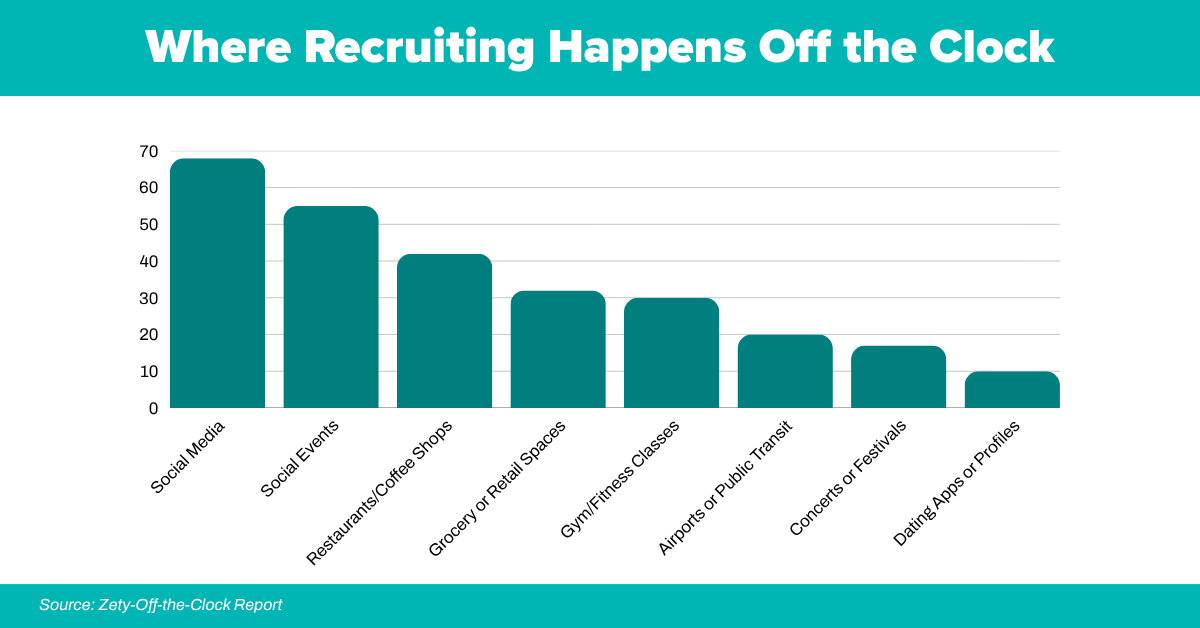
Top environments for informal recruiting include:
- Social media outside of LinkedIn: 68%
- Social events like weddings and parties: 55%
- Bars, restaurants, and coffee shops: 42%
- Grocery stores and retail spaces: 32%
- Gyms and fitness classes: 30%
- Airports and public transit: 20%
This reflects a broader shift. Talent discovery is happening wherever conversations and interactions take place, but employers still need a consistent way to move promising connections into a formal hiring process.
What Stands Out Without A Resume
In informal settings, hiring leaders may rely less on credentials and more on observable behavior.
Traits that stand out most include:
- Communication style and demeanor: 77%
- Personality and interpersonal skills: 65%
- Problem-solving or leadership behavior: 52%
- Industry knowledge in conversation: 49%
- Mutual connections or referrals: 36%
Without a resume, hiring leaders may rely more heavily on how someone communicates in the moment. That can surface valuable soft skills, but it also makes it important to avoid over-relying on first impressions without a consistent evaluation process.
For hiring teams, this highlights the importance of balancing soft skills with structured screening, clear role requirements, and fair evaluation criteria.
Does Informal Recruiting Actually Work?
Many hiring leaders say yes.
- Very effective: 31% say it often identifies strong candidates
- Somewhat effective: 53% say it occasionally yields good candidates
- Slightly effective: 14% say it rarely produces strong candidates
- Not effective: Only 2% say informal recruiting is usually unhelpful
In addition, many hiring leaders report following up with people they met outside of work about job opportunities.
Still, effectiveness does not mean informality should replace consistency. Any candidate identified outside a traditional channel should be brought into the same hiring process as other applicants, with clear expectations and fair evaluation criteria.
Informal recruiting is not replacing traditional hiring. It is expanding.

Why Professional Boundaries Matter
Informal recruiting can create opportunity, but it also raises questions about professionalism and boundaries. While 42% of hiring leaders say they would feel comfortable being approached by a job seeker in a non-work setting, many also recognize potential risks.
- 14% say professional boundaries can easily be crossed
- 41% say potential pitfalls exist but can be managed
- 30% say occasional issues may arise, but risk is generally low
- 15% say informal recruiting is safe and acceptable
As hiring moves into more personal environments, recruiters and hiring managers need to balance opportunity with professionalism.
That means being thoughtful about when and how to discuss potential opportunities, respecting personal context, and giving candidates a clear choice about whether they want to continue the conversation later in a more appropriate setting.
The Opportunity For Hiring Teams
The opportunity for hiring teams is not to rely on informal recruiting alone. It is to create a system that makes it easier to capture promising connections, follow up appropriately, and move interested candidates into a structured process.
Informal recruiting can help employers:
- Expand talent pipelines beyond active applicants
- Identify candidates earlier and in less competitive environments
- Evaluate communication and interpersonal skills in real time
- Build relationships before a formal hiring need opens
At the same time, informal recruiting alone is not scalable. It works best when paired with structured tools, broader reach, and a clear process for next steps.
How Hiring Teams Should Respond
To stay competitive, hiring strategies need to reflect how candidate discovery is changing.
Hiring teams should:
- Treat recruiting as an ongoing pipeline-building activity, not only a requisition-based process
- Create a simple way to capture and follow up with potential candidates identified outside formal channels
- Keep professional boundaries clear, especially in personal or social settings
- Use consistent evaluation criteria once a candidate enters the hiring process
- Use technology to organize, nurture, and scale candidate pipelines
The goal is not to replace traditional hiring. It is to strengthen it.
The Bottom Line
Informal recruiting is not replacing traditional hiring, but it is becoming part of how some hiring leaders identify talent.
For employers, the goal is not to turn every interaction into a recruiting opportunity. It is to recognize potential talent, follow up appropriately, and connect informal candidate discovery to a fair, structured hiring process.
The strongest hiring strategies combine broad reach, clear communication, and consistent evaluation with the flexibility to recognize talent wherever it appears.
Methodology
The findings are based on a nationally representative survey conducted by Zety, a Bold brand, using Pollfish on February 23, 2026.
The survey included 1,001 U.S.-based hiring decision-makers, including recruiters, HR professionals, and managers involved in evaluating or selecting candidates. It examined attitudes and behaviors related to informal recruiting in everyday settings such as social events, retail environments, gyms, and online platforms outside traditional professional channels.
Respondents answered a mix of question types, including multiple choice, scale-based, and open-ended questions. Data collection followed Pollfish quality standards to ensure reliability and accuracy.