

60% of job seekers say not knowing whether a human ever viewed their resume is one of the most frustrating parts of the application process.
That uncertainty is not just a perception problem. Alongside long applications, technical issues, and lack of feedback, it is affecting candidate behavior and eroding trust.
When the hiring process feels unclear, repetitive, or overly automated, candidates are more likely to disengage. Some abandon applications that take too long, while others lose confidence that their effort is being seen. The risk is a weaker pipeline with fewer completed applications, lower candidate confidence, and more friction before recruiters ever have a chance to connect.
What This Means for Recruiters
Candidate drop-off is no longer just about competition. It is about friction in the process.
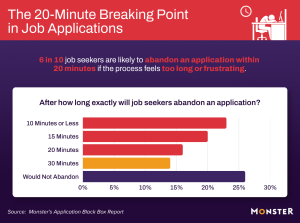
- Nearly 6 in 10 candidates abandon applications within 20 minutes
- 61% have experienced a resume upload error or technical issue while applying
- 55% say lack of updates or feedback after applying is a top frustration
Candidates are investing time, but many do not see a clear return. That is where engagement breaks down.
The 20-Minute Breaking Point
There is a clear threshold for candidate patience.
- 23% would abandon after 10 minutes or less
- 20% after 15 minutes
- 16% after 20 minutes
Together, that means nearly 6 in 10 job seekers would abandon an application by the 20-minute mark if the process feels too long or repetitive.
Re-entering resume information, unclear instructions, and slow systems can cause candidates to drop off before recruiters ever see them.
ATS Uncertainty is Shaping How Candidates Apply
Applicant tracking systems are central to hiring, but many candidates are skeptical of how they work.
- Only 6% believe ATS work well as they are
- 54% support either heavily regulating ATS or banning them entirely
At the same time:
- 40% regularly modify resumes to include keywords from job descriptions
Candidates are optimizing for systems they do not fully understand. That can shift candidate focus from simply showing fit to trying to understand how to get seen.
The Hidden Cost of Friction
The application itself is one of the first tests of candidate engagement. If the process is too long, repetitive, or technically difficult, candidates may leave before recruiters ever see them.
For recruiters, application friction can lead to:
- Lower application completion rates
- Fewer candidates reaching the review stage
- Increased difficulty maintaining a healthy top-of-funnel pipeline
Friction at the application stage weakens the entire pipeline.
Silence is Eroding Candidate Trust
Candidates are not just frustrated during the application process, they’re also disappointed by what happens after they apply.
- 60% say not knowing whether a human viewed their resume is their biggest frustration
- 52% named automated rejections with no explanation as a top frustration
Over time, that lack of visibility can create real risks for employers:
- Lower trust in the hiring process
- Reduced candidate engagement
- Greater frustration before recruiter outreach begins

The Opportunity for Recruiters
The good news for recruiters is that many of these issues are fixable. When recruiters improve clarity and reduce friction, they can:
- Make it easier for candidates to complete more applications
- Build more trust in the process
- Increase the time spent with candidates who are ready to move forward
Even small process improvements can make the experience feel more transparent, efficient, and candidate-friendly.
How Recruiters Should Respond
To improve candidate experience and reduce friction:
- Simplify application steps and reduce redundancy
- Provide clear status updates and feedback after submission
- Set expectations around timelines and next steps
- Minimize technical issues and resume-upload friction
- Make it easier for candidates to understand how applications are reviewed and what happens next
The goal is not just to attract candidates. It is to keep them engaged long enough to complete the process.
The Bottom Line
Today’s hiring process is often experienced as a black box. Candidates are investing time, but many do not see enough visibility, feedback, or progress after they apply.
That gap, combined with lengthy applications and technical friction, can contribute to drop-off and lower candidate engagement.
Recruiters who improve transparency and efficiency can create a hiring process that feels more responsive, more candidate-friendly, and easier to complete.
Methodology
This survey was conducted by Pollfish on February 7, 2026, among 1,002 currently employed U.S. workers. Respondents answered multiple-choice questions exploring resume writing challenges, job application friction, applicant tracking system confidence, and application abandonment behavior. The sample included 17% Gen Z, 27% Millennials, 27% Gen X, and 29% Baby Boomers. Respondents identified as 46% male and 54% female.