

Healthcare, transportation, sales, and logistics continue to drive hiring activity while candidate searches remain concentrated in broadly accessible roles.
The labor market regained momentum during the second quarter of 2026, with hiring activity strengthening from the start of the year and employer demand continuing to center on the roles that keep businesses, healthcare systems, and essential services running.
Monster’s Q2 2026 Market Report analyzes employer job postings, candidate search activity, and geographic hiring trends to identify the occupations, industries, and markets seeing the greatest momentum. The report points to a labor market that has largely stabilized, with hiring rebounding seasonally from Q1 while remaining below the elevated levels seen in prior years.
The biggest takeaway is not just where hiring demand is strongest, but where candidate interest may not fully align. Healthcare remains the largest source of employer demand, while transportation, logistics, customer service, retail, and sales also continue to generate strong hiring activity. At the same time, candidate searches remain focused on broadly accessible roles, creating a potential gap between what employers need and where job seekers are looking.
Key Findings for Employers:
- Healthcare remained the largest source of employer demand, with nursing-related occupations generating more job postings than any other profession. Demand for permanent nursing roles, including registered nurses, operating room nurses, and labor and delivery nurses, increased quarter over quarter, while travel nursing demand continued to moderate.
- Transportation, logistics, sales, and customer-facing roles continued to rank among the most-posted occupations, including truck and delivery drivers, sales representatives, retail sales, customer service, warehouse and logistics, cooks and food preparation, and security officers.
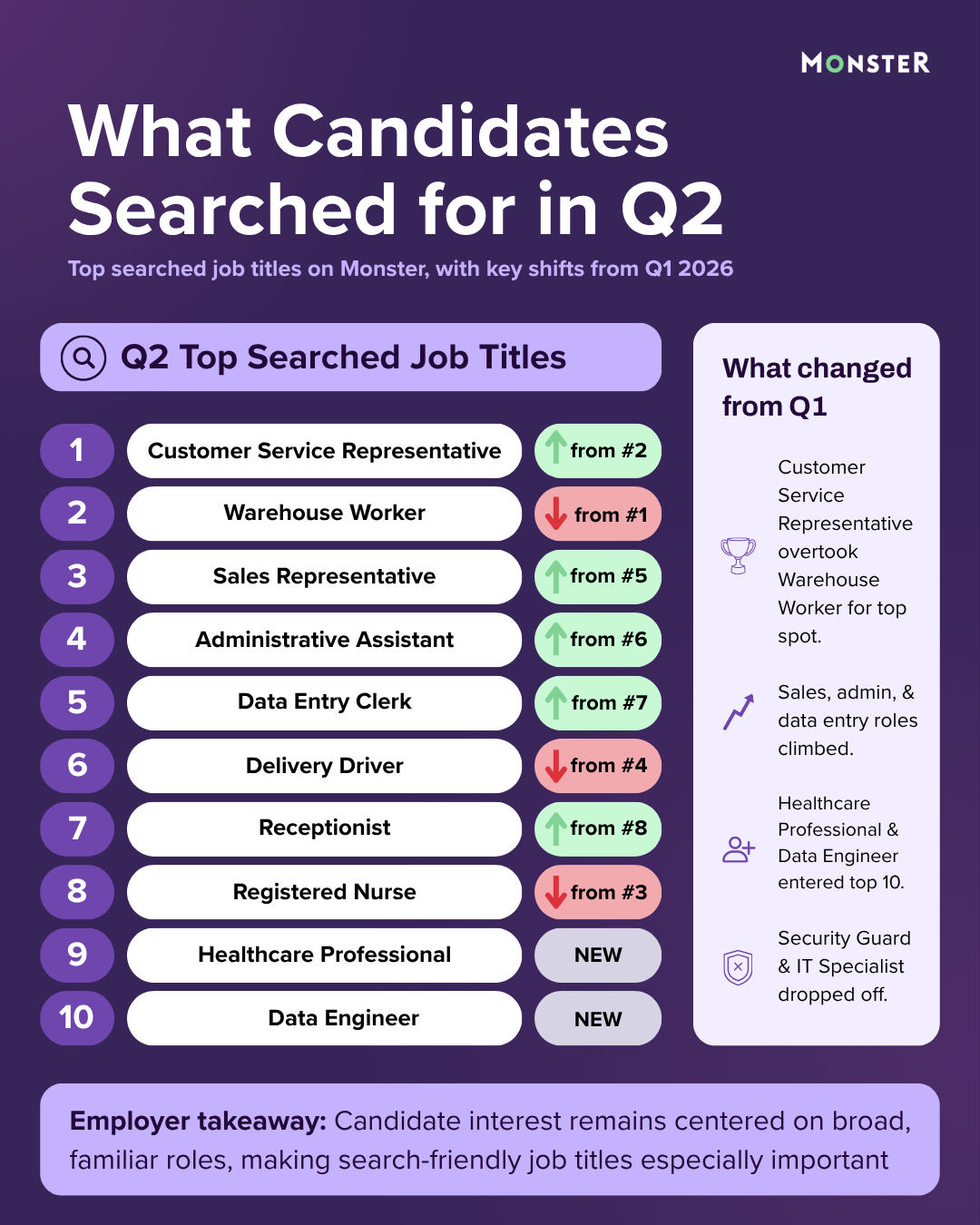
- Candidate search activity remains concentrated in broadly accessible roles, with customer service representative, warehouse worker, sales representative, administrative assistant, data entry clerk, delivery driver, and receptionist among the most-searched job titles.
- Several Midwest metros posted some of Monster’s strongest quarter-over-quarter hiring gains, including Minneapolis, Saint Paul, Cincinnati, Milwaukee, Dayton, and Indianapolis.
How Candidate Search Behavior Can Shape Recruiting Strategy
Candidate job search behavior tells a different story from employer hiring demand, highlighting a potential mismatch between where employers are posting jobs and where job seekers are focusing their searches.
The most-searched job titles during Q2 included:
- Customer Service Representative
- Warehouse Worker
- Sales Representative
- Administrative Assistant
- Data Entry Clerk
- Delivery Driver
- Receptionist
- Registered Nurse
- Healthcare Professional
- Data Engineer
Many of these positions offer accessible entry points into the workforce and are available across a wide range of industries. While employers are hiring heavily for healthcare and specialized roles, job seeker interest remains concentrated in customer service, administrative support, warehouse, sales, and delivery positions.
For hiring teams, this gap matters. If candidates are not searching for the roles employers most need to fill, job postings may need to do more work to capture attention. That could mean using clearer job titles, incorporating common search terms, highlighting transferable skills, or explaining why a role may be a strong fit for candidates coming from adjacent fields.
What this means for employers: Hiring teams should review job titles and descriptions through the lens of candidate search behavior. Internal titles may make sense inside the organization, but they may not match how candidates look for opportunities online.
Most-Posted Jobs on Monster in Q2 2026
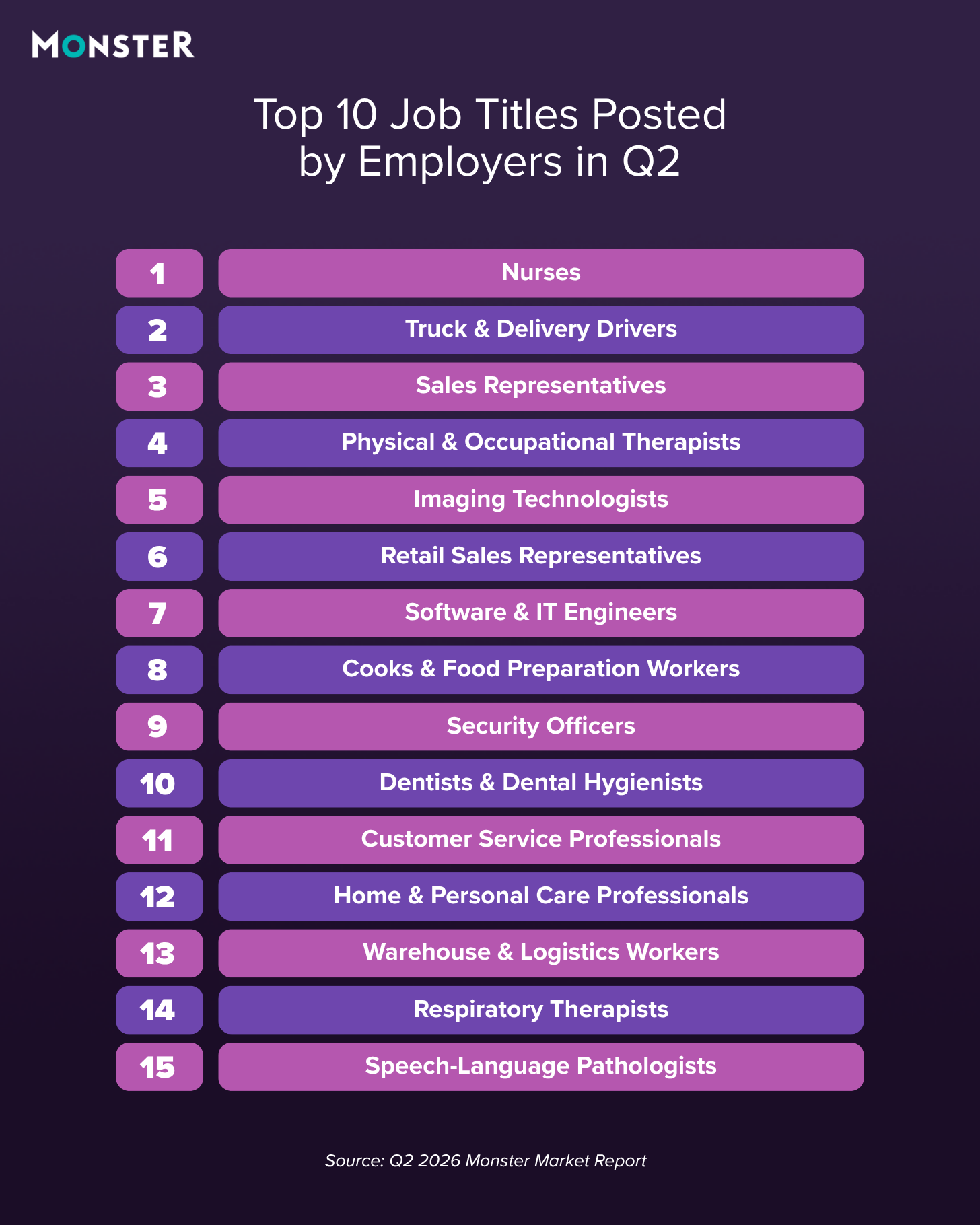
The following occupations generated the highest volume of employer job postings during the second quarter:
- Nursing Occupations
- Truck & Delivery Drivers
- Sales Representatives
- Physical & Occupational Therapists
- Imaging Technologists
- Retail Sales
- Software & IT Engineers
- Cooks & Food Preparation
- Security Officers
- Dentists & Dental Hygienists
- Customer Service
- Home & Personal Care
- Warehouse & Logistics
- Respiratory Therapists
- Speech-Language Pathologists
Healthcare continued to dominate hiring activity, reflecting sustained staffing needs across hospitals, outpatient clinics, rehabilitation centers, and other care settings. Within healthcare, Monster saw increased quarter-over-quarter demand for permanent nursing roles, while travel nursing demand continued to moderate. This may point to a healthcare hiring market increasingly focused on long-term workforce stability rather than short-term staffing solutions.
Outside healthcare, employers continued to recruit for roles that support day-to-day operations. Transportation, logistics, retail, customer service, and sales roles all maintained strong hiring activity as organizations looked to fill positions critical to moving goods, serving customers, and keeping business operations running.

Hiring Growth Expands Across the Midwest
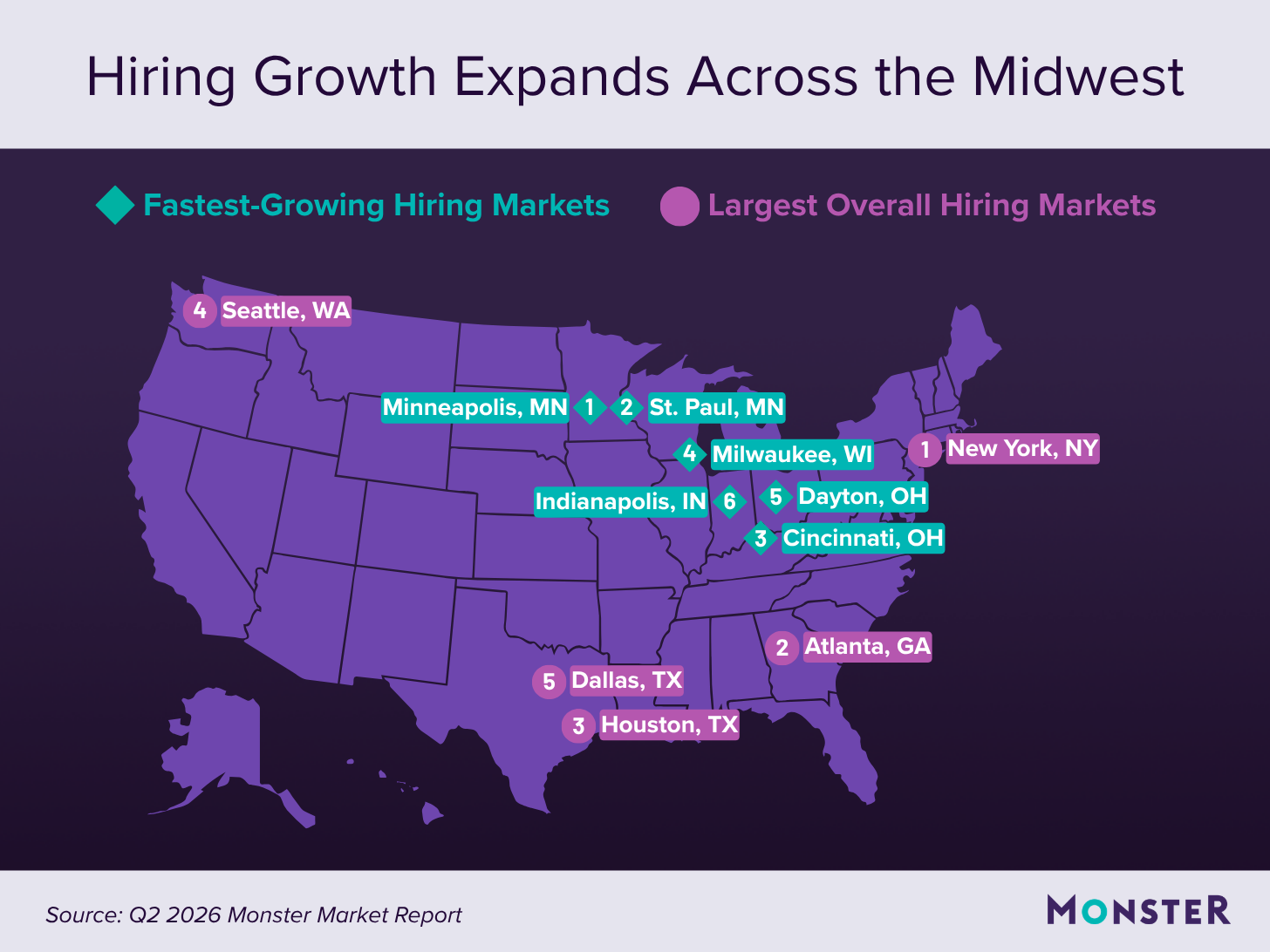
Although the nation’s largest metropolitan areas continued to account for the greatest overall hiring volume, some of the fastest hiring growth occurred in the Midwest during the second quarter.
Among the fastest-growing hiring markets on Monster were:
- Minneapolis, Minnesota
- Saint Paul, Minnesota
- Cincinnati, Ohio
- Milwaukee, Wisconsin
- Dayton, Ohio
- Indianapolis, Indiana
Meanwhile, the largest overall hiring markets remained:
- New York, New York
- Atlanta, Georgia
- Houston, Texas
- Seattle, Washington
- Dallas, Texas
Sun Belt hiring also remained strong, with Dallas, Charlotte, Phoenix, and Austin continuing to combine high posting volumes with meaningful quarter-over-quarter growth.
For employers, these trends reinforce the importance of local market awareness. National labor market headlines can provide helpful context, but recruiting conditions can vary widely by region. A role that is moderately competitive in one market may be much harder to fill in another, especially as hiring growth accelerates across emerging or rebounding metros.
What this means for employers: Hiring strategies should be adjusted by market, not just by role. Employers hiring in faster-growing Midwest metros may need to account for rising competition, while employers in large-volume markets may need to work harder to stand out.
What This Means for Employers Heading Into the Second Half of 2026
Monster’s Q2 Market Report points to a labor market that is active, but not booming across the board. Employer demand remains durable in the roles and regions that keep the economy moving, especially healthcare, transportation, logistics, sales, customer service, and retail.
It’s not just about whether candidates are available. It’s about whether the right candidates are searching for the right roles, in the right markets, with the right expectations.
To compete more effectively in the second half of 2026, employers should:
- Align job titles with how candidates actually search.
- Make job descriptions clearer, more specific, and easier to scan.
- Highlight stability and long-term opportunity in healthcare and specialized roles.
- Reduce friction in applications for high-volume operational roles.
- Use regional hiring trends to adjust sourcing, posting, and outreach strategies.
- Consider adjacent talent pools when candidate demand does not match employer need.
The Bottom Line
Monster’s Q2 2026 Market Report shows a labor market that has stabilized while remaining active in key areas. Healthcare continues to generate the largest share of employer demand, while transportation, logistics, sales, customer service, and retail remain essential drivers of hiring activity.
But the report also highlights a critical issue for employers: candidate search behavior does not always mirror employer demand. As hiring growth spreads across Midwest markets and employers continue to compete for specialized and operational talent, hiring teams may need to rethink how they position roles, where they source candidates, and how clearly they communicate opportunity.
Methodology
The Monster Market Report analyzes quarterly hiring activity using Monster’s proprietary database of online job postings and candidate searches. The analysis examines trends in employer demand and job seeker behavior across job titles, occupational categories, and geographic markets. This Q2 2026 edition analyzes activity during April through June 2026 and highlights the occupations, search trends, and regional markets generating the strongest hiring activity during the quarter. Historical comparisons are based on hiring activity observed across Monster’s marketplace over recent quarters.