

What Employers Need To Know About The Class Of 2026 And AI Readiness
Artificial intelligence is already shaping how new graduates learn, search for jobs, and think about their future careers.
But for employers hiring entry-level talent, Monster’s 2026 Graduate AI Readiness Report points to a growing challenge: many graduates are exposed to AI, but they do not always feel prepared to use it at work.
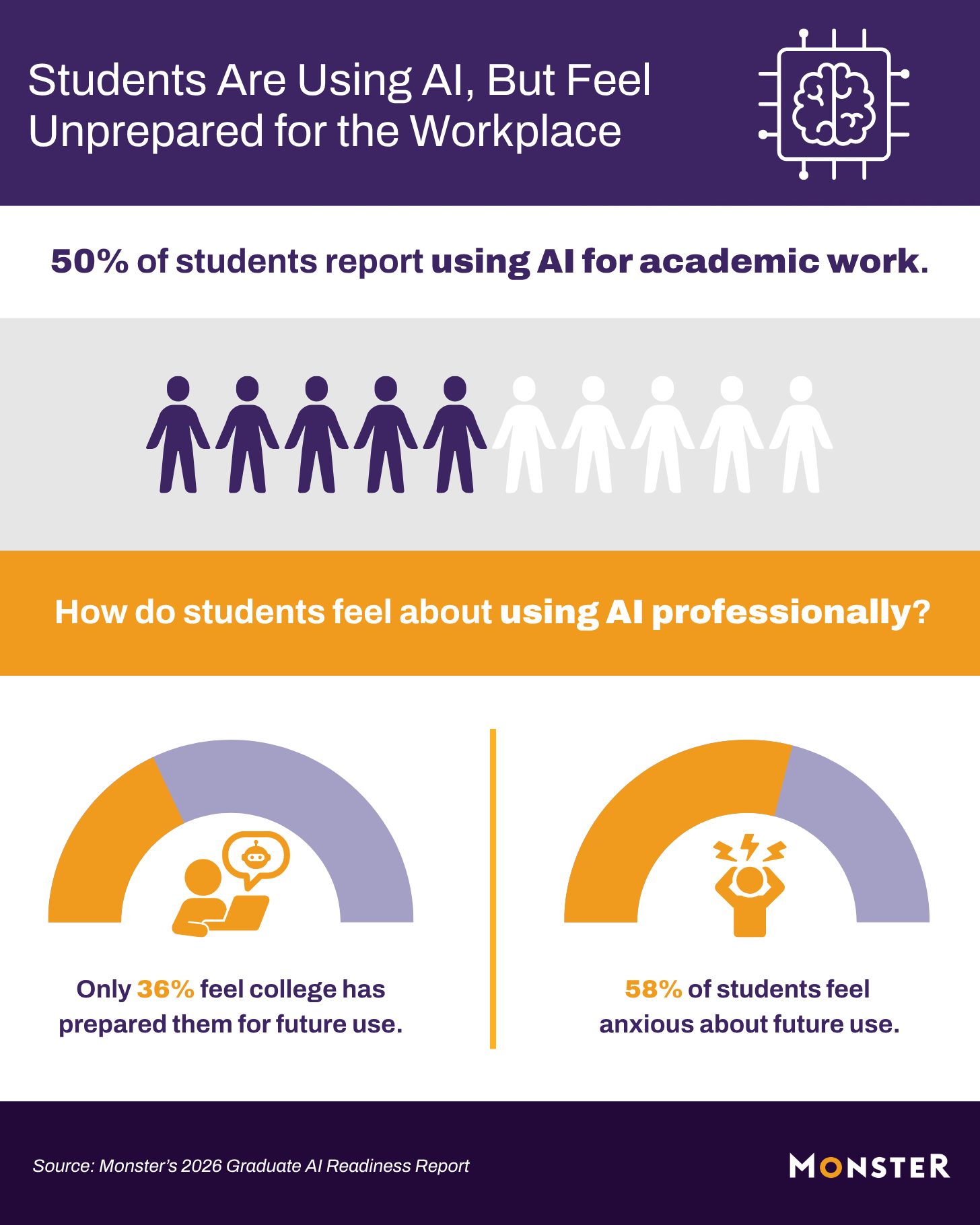
Nearly 9 in 10 graduates worry AI or automation could replace entry-level roles, up from 64% in 2025. At the same time, half have used AI tools in coursework or academic work, while only 36% say colleges are adequately preparing students to use AI in the workplace.
For employers, this creates both a recruiting challenge and a workforce development opportunity. New grads may see AI skills as necessary to compete, but many are entering the workforce with anxiety, uncertainty, and uneven levels of readiness.
Key Findings For Employers
- 89% of graduates worry AI could replace entry-level roles, up from 64% in 2025.
- 50% have used AI tools in coursework or academic work, showing that AI exposure is already common before graduates enter the workforce.
- Only 36% say colleges are preparing students to use AI in the workplace, while 40% say they are not and 24% are unsure.
- 58% feel anxious about using AI tools in their future workplace, creating a potential confidence gap for early-career employees.
- 69% believe knowing how to use AI will give them an advantage over other candidates, making AI skills part of how grads evaluate their competitiveness.
- 32% have not used AI in their job search or application process, showing that adoption is still uneven.
What This Means For Employers
The Class of 2026 is not entering the workforce unaware of AI. Many graduates are already using it in school, job searches, resumes, interview preparation, and company research. The issue is that exposure does not always equal confidence.
For employers, this means entry-level candidates may need more clarity around how AI is used in the workplace, what skills are expected, and how they will be supported as roles evolve.
This also changes how employers should think about “job-ready” talent. AI readiness is becoming part of early-career readiness, but many graduates are still learning how to apply AI tools in professional settings.
Employers that can clearly communicate expectations, provide training, and show how AI supports entry-level work may have an advantage with candidates who are anxious but eager to build relevant skills.
AI Is Creating Anxiety Around Entry-Level Roles
One of the strongest findings from Monster’s report is the sharp increase in AI-related concern. In 2025, 64% of graduates worried AI could replace entry-level roles. In 2026, that number rose to 89%.
That matters for hiring teams because anxiety can shape how candidates evaluate opportunities. Some graduates may also be questioning whether their chosen field will remain stable as AI changes the tasks, skills, and entry-level pathways that once defined early-career work.
New grads may wonder:
- Whether an entry-level role will still exist in a few years
- Whether AI will replace the tasks they are hired to do
- Whether they have the skills to keep up
- Whether the employer will train them or expect them to already know how to use AI
- Whether the role offers long-term growth in an AI-shaped workplace
These concerns do not mean graduates are rejecting AI. In fact, many see AI skills as a competitive advantage. But it does mean employers need to be more direct about how technology is changing entry-level work.

AI Exposure Is High, But Readiness Is Lower
Half of graduates say they have used AI tools in coursework or academic work. They are also using AI in the job search, including for job searching, resume writing or cover letters, interview preparation, applications, company research, and skills development.
But only 36% say colleges are adequately preparing students to use AI in the workplace.
That gap is important. A graduate who has used AI for school assignments may not yet know how to use it responsibly or effectively in a professional setting. They may need guidance on accuracy, confidentiality, judgment, collaboration, and when human review matters.
For employers, this is an opportunity to turn early-career AI anxiety into skill development. Training does not need to be limited to technical roles. AI literacy is becoming relevant across functions, including marketing, customer service, operations, recruiting, sales, finance, and administration.
AI Skills Are Becoming Part Of The Employer Value Proposition
Nearly 7 in 10 graduates believe knowing how to use AI will give them an advantage over other candidates.
That means AI is not only a workplace tool. It is also becoming part of how new grads think about career growth and employability.
Employers should consider how AI training, mentorship, and hands-on experience can strengthen their value proposition for early-career talent.
Job postings, career pages, and recruiter conversations can help by clearly communicating:
- Whether AI tools are used in the role
- What level of AI experience is expected
- Whether training is provided
- How employees are expected to review or validate AI output
- How AI supports productivity, learning, or decision-making
- What human skills remain important in the role
This can help reduce uncertainty and make roles feel more future-ready.

What This Means For Entry-Level Hiring Strategy
AI anxiety is not only a graduate issue. It has direct implications for employers trying to attract and retain entry-level talent.
If candidates believe AI could reduce entry-level opportunities, they may be more selective about roles that appear repetitive, unstable, or unclear. They may also look for employers that offer training, mentorship, and a clear path to build durable skills. That makes clarity especially important.
Employers hiring new graduates should review whether entry-level job postings clearly explain:
- Core responsibilities
- Skills candidates will build
- Training and onboarding support
- How AI is used in the role
- How performance will be evaluated
- Opportunities for growth
- The human skills that matter most
The goal is not to promise that roles will never change. It is to show candidates how the organization is preparing them to succeed as work changes.
How Employers Should Respond
Employers can use this data to strengthen both recruiting and early-career development.
First, make AI expectations clear. If AI skills are required, say so. If they are preferred but trainable, make that clear too. Avoid vague language that may discourage otherwise qualified candidates.
Second, provide practical training. New grads may be familiar with AI tools, but they still need workplace-specific guidance on how to use them responsibly, accurately, and effectively.
Third, connect AI readiness to long-term growth. Entry-level employees want to know that they are not just being hired into tasks that may change, but into roles where they can build judgment, adaptability, communication, and technical confidence.
The Bottom Line
The Class of 2026 is entering an AI-shaped workforce with both exposure and anxiety.
Graduates are using AI in school and in the job search, but many do not feel fully prepared to use it professionally. They see AI skills as an advantage, but they also worry about what automation means for entry-level opportunities, career paths, and the long-term value of their chosen fields.
For employers, the opportunity is to bridge that readiness gap. Hiring teams that provide clarity, training, and a stronger early-career value proposition can help new grads move from AI anxiety to AI confidence.
Methodology
This survey was conducted by Pollfish on February 17, 2026, among more than 1,000 U.S.-based recent and impending college graduates. Respondents answered a series of multiple-choice questions exploring job market outlook, job search expectations, AI readiness and concerns, and early-career priorities. The sample included graduates and students spanning the Classes of 2023 through 2027.