

For retailers and other consumer-facing businesses, the fourth quarter can make the year. Holiday retail sales surpassed $1 trillion for the first time in 2025, growing 4.1% over the previous year, according to the National Retail Federation. Meeting that demand requires companies to scale their workforces quickly. The need extends well beyond the store, too. E-commerce has created an enormous last-mile workforce that has to scale alongside it. UPS alone announced plans to hire 100,000 seasonal employees this year to support the increase in holiday package volume.
We tend to talk about all of this as a capacity problem. The holidays are coming, demand is going up and companies need more people. That’s obviously part of it, but it misses a larger opportunity. Companies spend a tremendous amount of time and money recruiting, screening and training seasonal workers, then put those people into real jobs during one of the most demanding periods of the year. Instead of treating that workforce as temporary labor that disappears in January, employers should think about seasonal hiring as a live audition for longer-term talent over the course of the season.
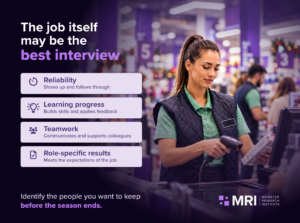
The job itself may be the best interview
Hiring is largely an exercise in trying to predict how someone will perform. We study resumes, conduct interviews, look at experience and increasingly use technology and AI to help determine whether someone has the skills to do the job. Seasonal hiring gives employers something more useful than a prediction: the opportunity to watch someone actually do the work.
Over the course of a season, you learn whether an employee shows up, learns quickly and works well with the team. You see how they interact with customers, how they adapt when things get busy and how they respond when something goes wrong. By the end of that period, the employee already knows the systems, products, processes and company culture. You’ve invested in training them, their manager knows how they perform, and the employee has had a chance to decide whether the company works for them too.
There’s evidence that this can become a real talent pipeline. In 2021, UPS reported that about a third of the people it had hired for seasonal package handler jobs over the previous three years were later hired into permanent positions after the holidays. The company also reported that approximately 138,000 of its then-current employees — nearly a third of its U.S. workforce — had started in seasonal positions.
Employers should be intentional about creating that opportunity. Before the season begins, define strong performance using consistent criteria such as reliability, learning progress, teamwork, and role-specific results. If you’re going to spend the season watching people perform, don’t wait until the audition is over to decide what you’re looking for.
As retail gets more automated, the human moments matter more
I’m bullish on what AI can do for recruiting. It can help employers source candidates, identify potential matches, automate repetitive work and move people through the process faster. But the point of the technology should be to help employers make better hiring decisions, not remove human judgment where it matters most.
In a retail landscape increasingly shaped by e-commerce, algorithms, automation and self-checkout, human connection remains one of the few parts of the customer experience technology can’t completely replicate. The employee answering a question, helping someone find a product, handling a return or delivering a package may be one of the only people a customer interacts with during the transaction. That makes qualities like empathy, warmth, adaptability and active listening particularly important, and those aren’t always easy to evaluate from a resume or application.
Seeing those qualities requires putting candidates in front of people, and doing it quickly. That’s one reason live, structured hiring events can be particularly useful for high-volume seasonal roles. They give employers an opportunity to observe how candidates communicate and interact while compressing a traditional hiring process that can take days or weeks into a much shorter window.
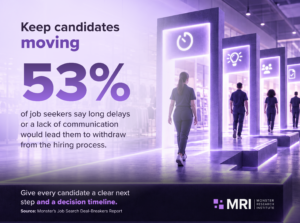
Speed matters because candidates aren’t necessarily waiting around for employers to make decisions. Monster’s Job Search Deal-Breakers Report found that 53% of job seekers say long delays or a lack of communication would lead them to withdraw from the hiring process. A hiring event should give candidates a clear next step and a timeline for the decision, even when an offer cannot be made that day.
To give hiring teams more time for those conversations, employers may need additional support. For employers managing a seasonal surge, Monster’s Source & Screen provides sourcing specialists who find candidates and screen for skills, experience, and role fit. That support can help build the pipeline for a hiring event while giving the employer’s team more time to interview candidates, assess their potential, and make hiring decisions.
Your customers may already be part of your talent pool
I’ve spent a good part of my career at the intersection of marketing and talent acquisition, and there’s another seasonal recruiting opportunity I don’t think enough consumer-facing companies consider.
Their customers.
Most consumer brands have spent years building loyalty programs, email databases, SMS lists and communities of repeat customers. Marketing teams know who shops frequently, who engages with the brand and, in many cases, who really loves the products. For customers who have appropriately opted into relevant communications, talent acquisition should at least consider whether some of that audience could also be a source of seasonal candidates.
Think about the starting point. These are people who already know your products, are familiar with your stores or services and understand the brand experience. They don’t necessarily need to be convinced that the company is worth engaging with because they’ve already chosen to engage with it.
Being a loyal customer obviously doesn’t make someone qualified for a job, but affinity is an interesting place to start a recruiting conversation. There can also be a natural network effect. The person receiving the message may not want a seasonal job, but their college-aged child, neighbor, friend or family member might.
The invitation doesn’t need to be complicated: Love our brand? Explore our seasonal opportunities, available shifts, employee benefits, and potential paths to long-term work. Make the opportunity concrete. Monster’s Job Search Deal-Breakers Report found that 60% of job seekers would not apply to a posting without a salary range. Familiarity with the brand can open the conversation, but candidates still need to know whether the job fits their needs.
Companies already use customer databases to drive store visits, product launches and promotions. Talent acquisition should consider how those same relationships could help reach prospective employees who already have an established connection to the brand.
Five years ago, I wrote in Forbes that hiring is a sales and marketing process and that candidates are like customers because there’s a journey before they buy. I still believe that. Seasonal hiring makes the relationship even more literal. Sometimes the customer actually is the candidate.
Don’t let January reset the pipeline
By January, employers have something most recruiting processes never get: months of information about the people they hired. They know who performed, who learned quickly, who customers responded to and who managers would hire again tomorrow. That’s talent intelligence, and companies should have a plan for what they’re going to do with it.
If there isn’t a permanent opening for a strong seasonal employee today, keep the relationship warm for the next one. If someone performed well in one location but there’s a need somewhere else, make that connection. And if your seasonal workforce has people with the potential to grow into bigger roles, don’t send them back into the labor market simply because the calendar changed.
Before seasonal employees leave, ask whether they want to be considered for future roles, document their skills and performance, and agree on how you’ll stay in touch.
The companies that get the most out of the holiday hiring season won’t just be the ones that successfully staff the fourth quarter. They’ll be the ones that come out of it knowing which people they want to keep.
Sources
https://nrf.com/research-insights/holiday-data-and-trends/winter-holidays/winter-holiday-faqs
https://www.reuters.com/business/world-at-work/ups-hire-100000-temporary-workers-ahead-peak-holiday-season-2026-10-07/
https://about.ups.com/mx/en/newsroom/press-releases/customer-first/ups-to-hire-over-100k-essential-seasonal-workers.html
https://www.icims.com/2025-frontline-hiring-report/
Thad Price is the SVP of Growth & Strategy at BOLD, a global career-technology company that builds and operates platforms supporting job seekers and employers across the hiring ecosystem.