

Monster’s Job Seeker Bill of Rights Report finds workers want greater transparency around open positions, hiring timelines, and talent pipeline recruiting.
A job posting creates a simple expectation: there’s a real opportunity behind it. But what happens when candidates apply to positions that have already been filled, are on hold, or were never intended for immediate hiring?
That uncertainty is fueling growing frustration among job seekers and raising new questions about hiring transparency.
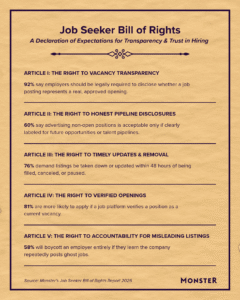
According to Monster’s Job Seeker Bill of Rights Report 2026, 92% of U.S. adults who searched for a job within the past two years believe employers and job platforms should be legally required to disclose whether an advertised position represents a current, approved vacancy.
The research also reveals an important distinction. Job seekers aren’t asking employers to abandon talent pipeline recruiting or long-term workforce planning. They want clarity about which opportunities are open now and which are intended for the future.
Key Findings for Employers
- 92% want greater disclosure: More than nine in 10 believe employers and job platforms should be legally required to disclose whether advertised positions represent current, approved vacancies.
- 58% would avoid repeat offenders: Job seekers say they would avoid employers that repeatedly advertise positions they aren’t actively trying to fill.
- 60% support transparent pipeline recruiting: Candidates are comfortable with employers advertising future opportunities when postings are clearly labeled.
- 76% expect timely updates: More than three-quarters want listings removed or updated within 48 hours after a job is filled, canceled, or paused indefinitely.
- 81% value verified openings: Job seekers would be more likely to apply if a job platform verified that a position represented a current vacancy.
Ghost Jobs Can Damage Employer Credibility
Ghost jobs, or postings that appear to represent active openings but aren’t being filled, have become a source of frustration for job seekers.
Monster found that 58% of respondents would avoid applying to an employer altogether if they learned the company repeatedly advertised positions it wasn’t actively trying to fill. Another 28% would withdraw an application already in progress, while 27% would warn other job seekers.
That creates a potential employer reputation problem. Candidates may remember an organization that appeared to waste their time, even when a legitimate opportunity becomes available later.
Not every outdated or inactive listing is intentionally misleading. Hiring needs change, budgets shift, and positions are sometimes placed on hold unexpectedly. But without clear communication, candidates may struggle to distinguish those situations from postings that were never intended to result in a hire.
Talent Pipeline Recruiting Isn’t the Problem. Lack of Clarity Is.
Building a talent pipeline is a legitimate part of workforce planning. Recruiters often want to connect with qualified candidates before positions officially open, especially for recurring, specialized, or high-volume roles.
In fact, 60% say employers should be allowed to advertise positions that aren’t currently open, provided those listings clearly identify themselves as future opportunities or candidate-pipeline recruiting.
Recruiters don’t necessarily have to choose between building future talent pools and maintaining candidate trust. The opportunity lies in making the distinction clear.
Rather than presenting a future opening as an active vacancy, employers can explain the purpose of the posting, what candidates can expect, and how their information may be used for upcoming opportunities.
Candidates Want to Know Where Things Stand
When Monster asked what information should be included in public job postings, respondents prioritized details about the hiring process:
- 60% want to know whether the employer is actively accepting applications.
- 44% want to know whether interviews are currently taking place.
- 39% want confirmation that the position has been approved and funded.
- 34% want an expected timeline for filling the position.
- 28% want disclosure if a posting is only collecting resumes for future openings.
These aren’t particularly complicated requests. They reflect a desire to make informed decisions about where to invest time and effort.
A candidate applying to an actively funded opening may approach the opportunity differently than someone expressing interest in a potential position six months down the road.
Keeping Job Listings Current Matters
Job postings can quickly become outdated as hiring priorities change. A position may be filled, put on hold, or canceled, but if the listing remains active, candidates may continue applying for an opportunity that’s no longer available.
Monster found that 76% of job seekers believe a listing should be removed or updated within 48 hours of a position being filled, canceled, or paused indefinitely. That includes 37% who expect the change to happen immediately.
Keeping listings accurate requires coordination between recruiters, hiring managers, and the tools used to advertise openings. Monster+ helps employers manage job postings through a central Jobs dashboard, giving hiring teams a place to review listings and manage job information.
Clear internal processes are just as important. Establishing ownership for job postings, regularly reviewing active listings, and communicating changes promptly can help prevent outdated opportunities from remaining visible. Together, these practices and the right recruiting tools can help employers maintain accurate listings and build candidate trust throughout the hiring process.
Verified Job Postings Could Help Rebuild Trust
As candidates become more cautious about online opportunities, verification may become an increasingly important trust signal.
Monster found that 81% of job seekers would be more likely to apply if a job platform verified that a position represented a current vacancy. More than half (51%) said verification would make them much more likely to apply.
The research also found that 74% believe legal disclosure requirements identifying whether positions are actively being filled would increase their confidence in online job listings.
Verification is only one piece of that experience. Accurate descriptions, clear hiring expectations, and consistent communication also help candidates assess whether an opportunity is worth pursuing.
What HR and Talent Acquisition Teams Can Do Now
Monster’s findings point to several practical opportunities to improve hiring transparency without overhauling the entire recruiting process.
Start by auditing current job listings. Identify postings that may no longer reflect active hiring needs, and confirm that open roles are accurately described.
Next, review how your organization communicates future opportunities. Pipeline recruiting can remain part of the strategy, but candidates should understand whether they’re applying for a current vacancy or expressing interest in future openings.
Finally, consider the candidate experience from the first interaction. Clear job descriptions, accurate hiring information, and timely updates can help establish credibility before a recruiter and candidate ever speak.
The Bottom Line
Monster’s Job Seeker Bill of Rights Report highlights a clear shift in candidate expectations. Job seekers want to know whether an opportunity is real, whether hiring is underway, and what they can expect from the process.
They aren’t asking employers to stop recruiting ahead. They’re asking for greater honesty about what is available today and what may become available tomorrow.
Transparency doesn’t have to complicate recruiting. Clearer job postings, accurate hiring updates, and straightforward communication can help employers build trust while continuing to develop talent pipelines for future needs.
Methodology
The Monster Job Seeker Bill of Rights Report 2026 is based on a survey conducted August 27 through September 3, 2026, among 1,011 U.S. adults who had searched for a job within the previous 24 months. The survey examined expectations around hiring transparency, current vacancies, talent pipeline recruiting, job listing accuracy, verification, and accountability.