
Employers hiring for high-volume frontline roles may be defining their talent pools too narrowly.
According to Volume 2 of Monster’s Workforce Mobility Report, Cashier appeared as either the prior or destination title in 11 pathways ranking among the 20 largest cross-title routes observed among high-volume roles.
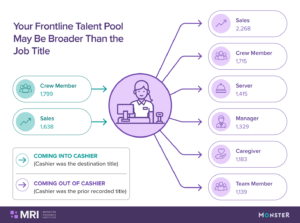
Monster analyzed 370,509 resume-observed position changes involving different recorded titles. The largest pathway was Cashier to Sales, with 2,268 transitions. Sales to Cashier also ranked among the largest, with 1,638.
Movement between Cashier and Crew Member was nearly balanced, with 1,715 transitions from Cashier to Crew Member and 1,799 in the opposite direction.
Cashier also connected with Server, Manager, Caregiver, Team Member, Customer Service Representative, Delivery Driver, Barista and Cook. These connections crossed retail, sales, hospitality, customer service, healthcare support and logistics.
These patterns highlight an opportunity to look beyond exact job titles when sourcing frontline candidates. Workers regularly move between cashier positions and roles in sales, customer service, hospitality, and other fields, bringing experience that may be relevant across industries.
For employers, that raises a practical question: Are exact-title requirements causing employers to overlook potentially relevant frontline experience?
Key Findings for Employers
- Cashier was a central frontline role: It appeared in 11 pathways ranking among the 20 largest cross-title routes analyzed.
- Sales was the largest connection: Monster observed 2,268 transitions from Cashier to Sales and 1,638 in reverse.
- Movement went both ways: Cashier-to-Crew Member transitions totaled 1,715, compared with 1,799 in the opposite direction.
- Connections extended beyond retail: Cashier was linked to hospitality, customer service, healthcare support, and logistics roles.
- Job titles tell only part of the story: The findings highlight the value of looking beyond exact-title matches when evaluating frontline experience.
Cashier Sits at the Intersection of Multiple Talent Pools
The top-ranked Cashier pathways included:
| Rank | Prior recorded title | Destination title | Observed transitions |
| 1 | Cashier | Sales | 2,268 |
| 3 | Crew Member | Cashier | 1,799 |
| 4 | Cashier | Crew Member | 1,715 |
| 5 | Sales | Cashier | 1,638 |
| 9 | Cashier | Server | 1,415 |
| 11 | Cashier | Manager | 1,329 |
| 13 | Cashier | Caregiver | 1,183 |
| 14 | Cashier | Team Member | 1,139 |
| 16 | Cashier | Customer Service Representative | 985 |
| 18 (tie) | Server | Cashier | 942 |
| 18 (tie) | Team Member | Cashier | 942 |
Pathways are ranked by observed transition count. Two pathways tied for the 18th position, and both are included. Job titles are presented as recorded in the source data.
Cashier was the prior title in seven of these pathways and the destination title in four. No other title appeared as frequently among the largest observed routes.
Cashier is itself a high-volume title, so the results should not be interpreted as showing that it causes these transitions or is uniquely likely to lead to another role. Its prominence nevertheless makes it a useful example of how a seemingly narrow title can connect multiple frontline talent pools.
Adjacent Experience Can Work in Both Directions
Employers often define adjacent experience from the perspective of one opening. The data show that these connections can operate in both directions.
| Connected title | Cashier to role | Role to Cashier |
| Sales | 2,268 | 1,638 |
| Crew Member | 1,715 | 1,799 |
| Server | 1,415 | 942 |
| Manager | 1,329 | 890 |
| Team Member | 1,139 | 942 |
| Customer Service Representative | 985 | 786 |
| Caregiver | 1,183 | 466 |
| Delivery Driver | 774 | 504 |
| Barista | 750 | 452 |
| Cook | 624 | 500 |
The reciprocal movement suggests that employers in connected areas may be drawing from overlapping pools of prior-title experience.
This matters for sourcing. A retailer hiring Cashiers might consider candidates from food service, customer service, care or delivery backgrounds. An employer hiring Sales, Crew Members or Customer Service Representatives may find relevant experience among Cashiers.
Move From Title Matching to Skills Mapping
A title is an imperfect shorthand for a person’s experience. “Cashier” could describe someone who primarily processes transactions or someone who also:
- Resolves complex customer problems
- Recommends products and services
- Works toward sales goals
- Manages inventory
- Trains new employees
- Opens and closes a location
- Follows cash-control and security procedures
- Coordinates with multiple departments
- Handles high transaction volumes
- Supports shift leadership
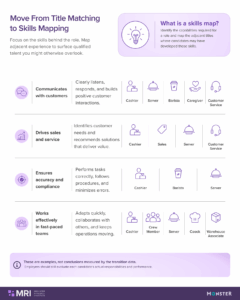
Employers can improve frontline sourcing by identifying the capabilities required for a role and mapping the adjacent titles in which candidates may have developed them.
| Hiring requirement | Potential evidence from adjacent experience |
| Customer communication | Cashier, Server, Barista, Caregiver, Customer Service Representative |
| Sales ability | Cashier, Sales, Server, Customer Service Representative |
| Transaction accuracy | Cashier, Barista, Server |
| Fast-paced operations | Cashier, Crew Member, Server, Cook, Warehouse Associate |
| Problem-solving | Cashier, Customer Service Representative, Caregiver |
| Team coordination | Crew Member, Team Member, Cook, Warehouse Associate |
| Inventory handling | Cashier, Crew Member, Warehouse Associate |
| Training or informal leadership | Cashier, Team Member, Crew Member, Manager |
These are examples, not conclusions measured by the transition data. Employers should still evaluate each candidate’s actual responsibilities and performance.
Reconsider Exact-Title Requirements
Exact-title experience matters when a role requires a specific credential, license or specialized background. For many frontline positions, however, a job title may simply be a proxy for the skills an employer actually needs.
Before requiring an exact title, hiring teams should identify the capabilities that are truly essential and consider where candidates may have developed them. Then, review sourcing and screening practices to make sure adjacent experience is not being excluded unnecessarily.
Consider whether:
- Search strings include relevant adjacent titles
- Screening questions focus on essential skills and experience rather than title alone
- Recruiters and hiring managers understand which capabilities can transfer across frontline roles
- Automated screening tools place too much weight on exact title or keyword matches
- Job descriptions help candidates recognize how their experience may apply
The goal is not to lower hiring standards. It’s to make sure job-title conventions do not become a substitute for evaluating what candidates have actually done.
Make the Opportunity Meaningfully Different
The movement between Cashier and several connected roles also has implications for employer differentiation.
Candidates considering related frontline positions may compare:
- Compensation
- Guaranteed hours
- Schedule predictability
- Benefits
- Staffing levels
- Workload
- Management support
- Training
- Advancement
- Stability
- Commute
A new title alone may not be enough to make an opening attractive. Employers should explain what materially improves for the candidate.
That is especially important when recruiting someone who already possesses relevant frontline experience. The candidate may understand the basic responsibilities and focus more heavily on whether the organization offers a better employment experience.
Build Internal Pathways Across Frontline Roles
The same connections employers use for external sourcing can inform internal mobility.
Organizations with multiple frontline functions can identify how employees might move among:
- Cashier and Sales
- Cashier and Customer Service
- Cashier and Team Member
- Cashier and Crew Member
- Cashier and shift or store leadership
- Customer-facing and operational roles
Internal pathways should define:
- Required skills
- Available training
- Performance expectations
- Pay progression
- Promotion criteria
- Typical time frames
- The responsibilities added at each step
Without that visibility, employees may leave the organization to pursue a related role elsewhere.
Frontline Talent Is Broader Than Its Titles
Cashier’s prominence in the largest cross-title pathways doesn’t prove that every Cashier is qualified for adjacent work. It demonstrates why employers should examine the experience beneath a familiar title.
Frontline talent pools do not divide neatly according to the labels employers place on jobs. Workers bring customer service, sales, operational and problem-solving experience across settings, often under different titles.
Employers that map shared skills, expand relevant sourcing titles and make career progression visible may be better positioned to find qualified candidates and retain the talent they already have.
About the Monster Workforce Mobility Report
The Monster Workforce Mobility Report is a two-volume analysis of 990,922 resume-observed position changes recorded from January through July 2026. Volume 1: The Stickiest Job Titles examines transitions that retained the same recorded title. Volume 2: Cashier as a Frontline Career Hub examines transitions between differently recorded titles and Cashier’s prominence among the largest cross-title pathways.
Methodology
Monster analyzed 990,922 resume-observed position changes from January through July 2026. This report focuses on 370,509 transitions ending in one of the 20 highest-volume destination roles where the prior and destination job titles differed.
Transitions were identified by tracking changes in recorded job titles, employers, or both. A single individual could contribute multiple transitions, so findings reflect position changes rather than unique workers.
Pathways were ranked by observed transition volume using exact recorded job titles. The analysis did not account for title prevalence or measure skills, compensation, responsibilities, or reasons for changing roles. Findings do not establish that cashier experience makes a particular career move more likely and should not be generalized to the broader U.S. workforce.