

Employers recruiting for high-volume roles may be competing primarily for people who already hold the same title somewhere else.
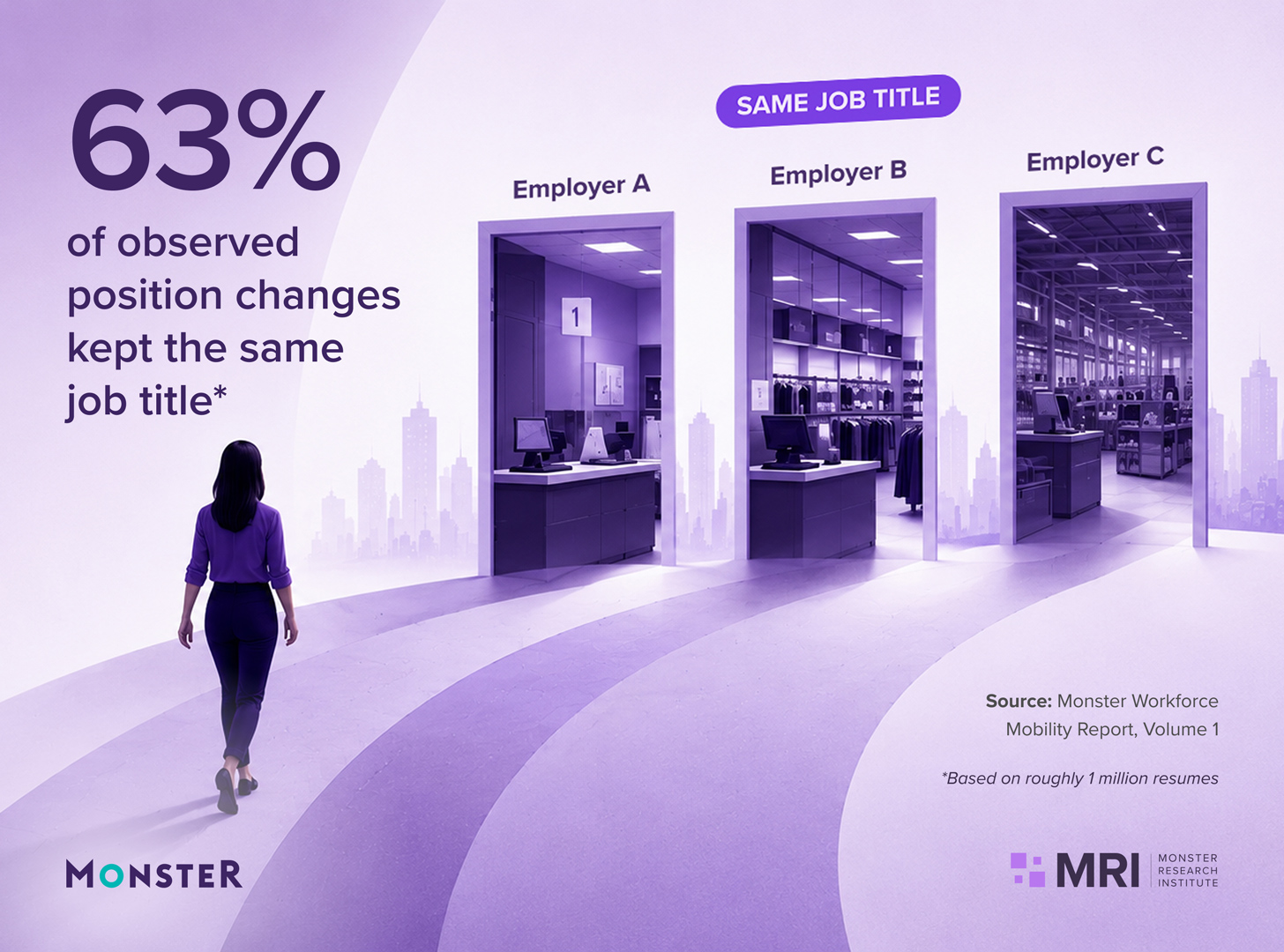
Monster analyzed 990,922 resume-observed position changes ending in 20 high-volume roles and found that 620,413, or 63%, retained the exact same recorded title.
Because a position change without a title change reflects movement to a different employer, the data show substantial employer-to-employer movement among people continuing under the same title.
The pattern appeared across every role analyzed. Same-title rates ranged from 55% for Delivery Driver to 72% for Certified Nursing Assistant. More than half of transitions into every destination role came from the exact same recorded title.
For HR and talent acquisition teams, the implication is direct: in many high-volume searches, the experienced candidate one employer hopes to attract may be leaving the same role at another organization.
The job’s standard responsibilities may already be familiar to that candidate. Compensation, scheduling, management, workload and advancement may be what distinguish one employer from another.
Key Findings for Employers
- Nearly two-thirds of position changes retained the same title: Of the 990,922 transitions analyzed, 620,413, or 63%, involved movement to another employer under the same recorded title.
- Every title studied showed substantial continuity: More than half of transitions into each of the 20 roles came from the exact same title.
- Healthcare support roles had the highest rates: Certified Nursing Assistant led at 72%, followed by Medical Assistant at 71%.
- Hospitality employers also compete for same-title talent: Bartender had a 70% same-title rate, followed by Server at 67%.
- High-volume customer-facing roles showed strong continuity: Crew Member and Cashier each had same-title rates of 66%, while Customer Service Representative had a rate of 63%.
- Even roles with lower exact-match rates drew heavily from same-title experience: Delivery Driver retained the same recorded title in 55% of observed transitions.
The 20 Stickiest Job Titles
| Rank | Destination job title | Same-title transitions | Same-title rate |
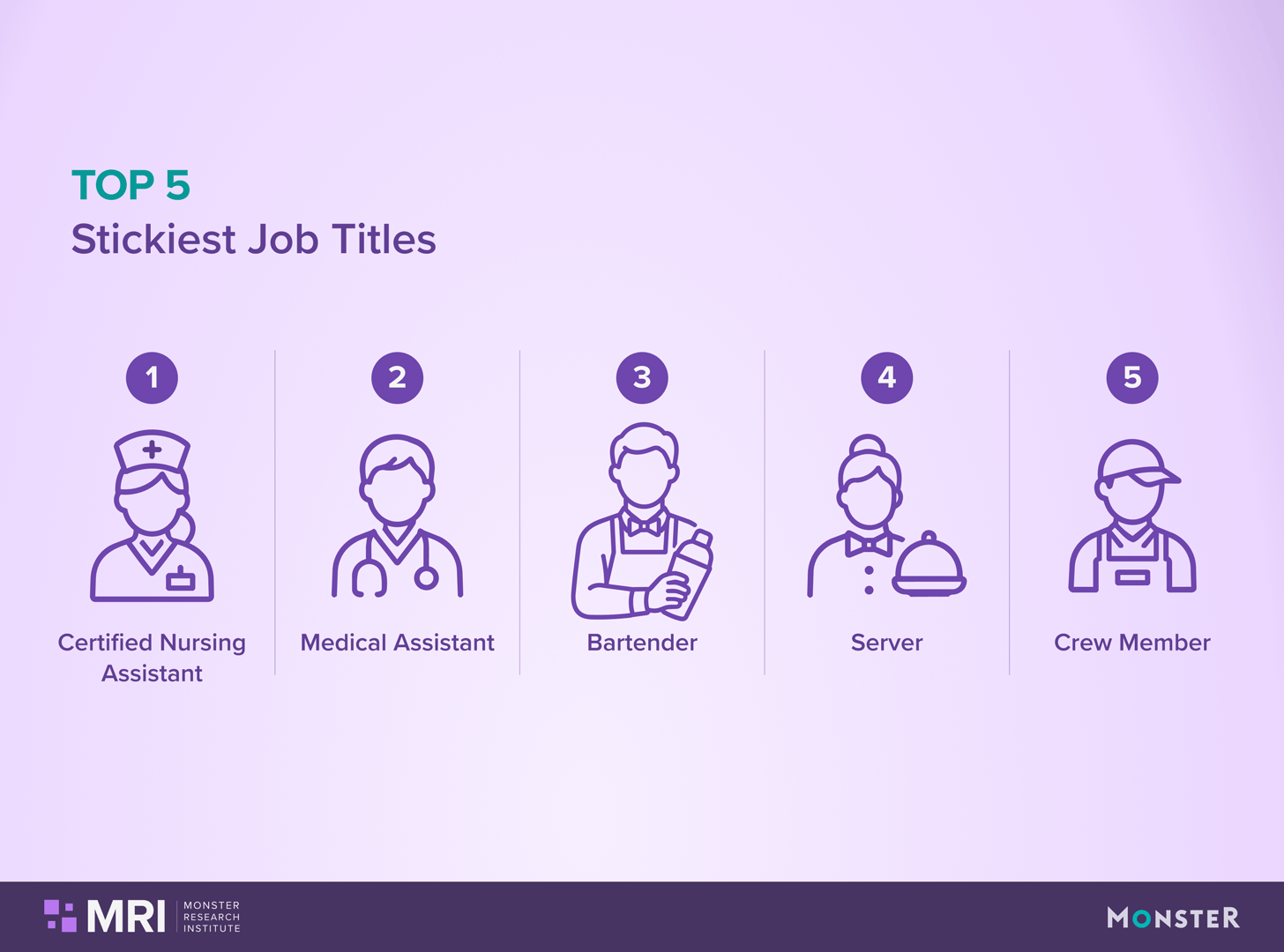
| 1 | Certified Nursing Assistant | 30,167 | 72% |
| 2 | Medical Assistant | 21,575 | 71% |
| 3 | Bartender | 21,772 | 70% |
| 4 | Server | 48,952 | 67% |
| 5 | Crew Member | 38,682 | 66% |
| 6 | Cashier | 63,322 | 66% |
| 7 | Administration Assistant | 18,342 | 64% |
| 8 | Customer Service Representative | 40,821 | 63% |
| 9 | Security Officer | 18,986 | 63% |
| 10 | Barista | 16,738 | 63% |
| 11 | Manager | 53,970 | 62% |
| 12 | Team Member | 24,252 | 62% |
| 13 | Laborer | 16,865 | 62% |
| 14 | Sales | 50,312 | 61% |
| 15 | Receptionist | 22,281 | 60% |
| 16 | Cook | 18,783 | 60% |
| 17 | Warehouse Associate | 21,938 | 58% |
| 18 | Driver | 23,624 | 56% |
| 19 | Caregiver | 28,022 | 56% |
| 20 | Delivery Driver | 41,009 | 55% |
Rankings are based on unrounded rates. Displayed percentages are rounded to the nearest whole number. Job titles are presented as recorded in the source data.
Recruiting and Retention Are Two Sides of the Same Market
A same-title transition creates two simultaneous workforce events:
- One employer gains someone with direct experience in the role.
- Another employer loses someone who was already performing that work.
This connects external recruiting with internal retention. Employers are not simply trying to find people capable of becoming Cashiers, Servers, Medical Assistants or Customer Service Representatives. They are often trying to attract people already holding those titles elsewhere.
That means the same factors used to recruit experienced candidates may also determine whether current employees stay:
- Compensation
- Schedule predictability
- Benefits
- Management quality
- Workload
- Staffing
- Training
- Stability
- Workplace culture
- Advancement opportunities
If an organization cannot clearly explain why its version of the job is better, candidates may see little reason to move and existing employees may see little reason to remain.
High Stickiness Raises the Stakes for Employer Differentiation
Job descriptions often focus heavily on standard responsibilities. That information is necessary, but it may not be especially persuasive to someone who already performs the role.
An experienced Server already understands the basics of serving customers. A Medical Assistant already knows the general nature of the work. A Cashier does not need a long explanation of what operating a register involves.
These candidates may be more interested in:
- What the position pays
- How frequently schedules change
- Whether hours are guaranteed
- When benefits begin
- How teams are staffed
- What managers are expected to provide
- How performance is evaluated
- Whether pay grows with skills or tenure
- Where the role can lead
- Why current employees stay
For familiar roles, the job description should spend less time restating obvious duties and more time explaining the employment experience.
Treat Experienced Candidates Like Experienced Candidates
Employers seeking someone who already holds the title should ensure the hiring process acknowledges that experience.
This does not mean skipping necessary evaluation or verification. It means avoiding friction that does not improve the hiring decision.
Hiring teams can review whether they are:
- Asking experienced candidates to complete unnecessary entry-level assessments
- Requiring redundant demonstrations of basic tasks
- Conducting too many interview rounds
- Delaying decisions in high-volume markets
- Withholding compensation information
- Failing to explain how the opportunity differs from the candidate’s current role
A candidate who already performs the job may have several comparable options. A slow or repetitive hiring process can make the opportunity less attractive.
Examine Why Employees Leave the Same Role
The data do not identify why workers changed employers. Organizations can answer that question within their own workforce.
Useful sources include:
- Exit interviews
- Stay interviews
- Engagement surveys
- Manager-level turnover data
- Schedule and attendance patterns
- Compensation benchmarking
- Internal application data
- Promotion rates
- Time in role
- Employee referrals
- Benefits utilization
Employers should look for patterns by location, shift, manager and tenure. A companywide turnover rate may hide a specific scheduling, staffing or management problem.
The goal is to understand why employees are willing to take the same title somewhere else.
Make Progress Possible Without Requiring Employees to Leave
A sticky title can become a retention risk when employees cannot see how remaining with the organization will improve their careers.
Employers can create progress within a role through:
- Skills-based pay increases
- Senior or specialist levels
- Cross-training
- Mentorship responsibilities
- Certification support
- Shift leadership
- Expanded authority
- Clear promotion criteria
- Internal mobility opportunities
- Published career paths
Not every employee wants a management position. Career development can also mean greater expertise, higher pay, more predictable work or access to preferred schedules.
Same Title, Different Employer Value Proposition
Nearly two-thirds of the observed position changes retained the same recorded title. For employers, that means high-volume recruiting frequently involves convincing experienced workers to perform familiar work somewhere new.
The title and core responsibilities may not differentiate the opportunity. The employer value proposition must do that work.
Organizations that can clearly communicate better compensation, scheduling, management, stability and advancement may be better positioned to attract experienced candidates. Those same qualities can also reduce the number of current employees leaving to take the same title elsewhere.
About the Monster Workforce Mobility Report
The Monster Workforce Mobility Report is a multi-volume analysis examining how workers move among employers and job titles. It is based on 990,922 resume-observed position changes recorded from January through July 2026.
Volume 1: The Stickiest Job Titles examines transitions that retained the same recorded title.
Volume 2: Cashier as a Frontline Career Hub examines movement between differently recorded titles and Cashier’s prominence among the largest cross-title pathways.
The Monster Workforce Mobility Report is a multi-volume analysis of 990,922 resume-observed position changes recorded from January through July 2026. Volume 1: The Stickiest Job Titles examines transitions that retained the same recorded title. Volume 2: Cashier as a Frontline Career Hub examines transitions between differently recorded titles and Cashier’s prominence among the largest cross-title pathways.
Methodology
Monster analyzed 990,922 resume-observed position changes recorded from January through July 2026. The analysis was limited to transitions ending in the 20 highest-volume destination job titles available in the dataset.
Resumes were tracked over time, with changes producing “from” and “to” values for job title, employer and location. A change in job title, employer or both was counted as a position change. A single resume or individual could contribute more than one transition. Accordingly, the unit of analysis was position changes, not unique workers.
Same-title transitions were based on exact matches between the recorded prior and destination job titles. Differently worded titles may represent similar or equivalent occupations but were counted as different unless their recorded title strings matched exactly.
The 990,922 position changes represent transitions ending in the 20 roles analyzed, not all position changes captured in the dataset. Because additional destination-title data were unavailable, the results should not be generalized to all job titles, all position changes or the broader U.S. workforce.